Fertiliser timing Kenya extension officers hand out to farmers usually comes as a date: basal at planting, top-dress at knee height, second split before flowering. It is easy to teach and easy to write on a subsidy voucher. It is also, according to the trial data available for East Africa, a poor predictor of whether that fertiliser actually turns into grain.
The advice as it is usually given
Most smallholder guidance in Kenya follows a fixed sequence tied to weeks after planting or to visible growth stages such as knee-high maize. It is a reasonable simplification for training material distributed at scale, and it does not require the farmer to know anything about the soil under their own field. Blanket fertiliser recommendations of this kind come out of research stations, tested on a handful of representative plots, and then extended across zones that share a rainfall pattern but not necessarily a soil type.
The Cambridge study on maize fertiliser use efficiency is blunt about the consequence: blanket recommendations derived from research stations are often not adopted, and are not likely to be effective, because of the high diversity of soils and farmers' resources across East Africa. That is not a comment on farmer behaviour. It is a comment on the recommendation itself, built for an average soil that does not exist on most individual farms.
Where the calendar rule comes from
The date-based rule is not arbitrary. It is built from average crop development timelines under average rainfall, and it works reasonably well when both of those averages hold. The problem is what happens at the edges: a late onset of rains, a soil that drains fast, a field that has carried maize season after season without a break. None of those show up on a printed calendar, and all of them change whether nitrogen applied on schedule actually gets taken up by the plant rather than sitting inert in the profile.
The 464 on-farm trials across Kenya, Rwanda, Tanzania and Uganda analysed in the Cambridge paper found significant variation in production risk and nutrient use efficiency by season and by soil type, not primarily by planting date. Two fields planted on the same day, in the same rainfall zone, can behave completely differently depending on what is underneath them. The paper treats this as the central finding, not a footnote, because it explains why a recommendation that performs well at a research station can fail on a farm a short drive away, with identical weather and an identical planting date.
A calendar date is a proxy for two things at once: how far along the crop should be, and what the soil should be doing by that point in the season. When both proxies hold, the date works fine. When the soil classification changes how water and nutrients move, the second proxy breaks down quietly, with nothing visible above ground to warn the farmer that the timing built into the calendar no longer matches what is happening at root level.
The soil type problem the calendar ignores
On most sites in the four-country trial, except Uganda, production risk was lower with recommended nitrogen and phosphorus than with no fertiliser at all, in both the short and long rains. But the size of that advantage depended heavily on soil classification. On Lixisols and Ferralsols, production risk with N and P fertiliser was three to four times higher than on the control plots. On Nitisols, Leptosols, Vertisols, Plinthosols and Cambisols, the risk was much lower.
The probability of exceeding 3 tonnes per hectare of maize grain with recommended N and P rates was over 0.60 on Nitisols and Leptosols. On Lixisols and Plinthosols it was under 0.20. A farmer on a Lixisol following the exact same calendar and rate as a farmer on a Nitisol is playing a different game, and the calendar tells neither of them that.
Agronomic use efficiency of nitrogen and phosphorus, and the value cost ratio that determines whether the input pays for itself, were highest on Cambisols and lowest on Plinthosols in the same dataset. Net present value calculations showed fertiliser was profitable in only 30 percent of site-by-season combinations in Uganda, against 69 percent in Kenya, 81 percent in Rwanda and 84 percent in Tanzania. Kenya sits well above Uganda but still leaves three in ten combinations unprofitable regardless of when the fertiliser goes in.
What moisture stress does to a well-timed application
The Cambridge paper names the mechanism behind a lot of that variability: inefficient uptake of nutrients by crops during periods of moisture stress. Fertiliser applied at the textbook date but during a dry spell sits in the soil profile largely unused. It has not failed because the date was wrong in the abstract. It has failed because the plant could not take it up when it needed water to move nitrogen from soil solution to root.
This is where reading soil conditions rather than a date becomes concrete rather than theoretical. A probe reporting the moisture state of the root zone, at the depth where the crop is drawing water, tells a farmer something a printed schedule cannot: whether the soil right now can move a fresh dose of nitrogen to the plant, or whether it will sit inert until the next rain. Our own soil sensors report relative moisture on a percent-of-scale basis at a shallow and a deeper probe, which is a proxy for exactly this kind of decision, not a replacement for the agronomy behind it. A shallow probe reading that has dropped hard over several uplinks tells you more about whether nitrogen will move than the number itself does in isolation.
What the Kenyan potato trial actually showed about split timing
A two-season Kenyan trial on the potato cultivar Dutch Robjyn tested three nitrogen sources (CAN, urea, ASN), three timings (early, split, late) and two placement methods. Early nitrogen, followed closely by split application, produced faster early growth: more shoot, tuber and root dry matter, greater leaf area, taller plants, particularly where CAN or ASN was the source. Late nitrogen application, by contrast, boosted shoot growth later in the season, particularly with urea.
That result answers a narrower question than a farmer might want. It tells you what timing does to potato growth stages under the conditions of that trial, not what timing does for every crop or soil in the country. It also found that broadcasting versus furrow placement made no significant difference, which quietly undercuts a lot of advice about precise placement mattering more than the timing decision itself. Read alongside the Cambridge soil-type findings, the potato trial is a reminder that timing is crop-specific as well as soil-specific: a rule derived from Dutch Robjyn potato under trial conditions cannot be lifted straight onto maize on a different soil class, even in the same district.
There is a second lesson in that trial that gets less attention: the choice of nitrogen source changed which timing worked. CAN and ASN paired well with early or split timing, urea paired better with late timing. A farmer switching fertiliser brand mid-season because of price, without adjusting timing to match, is quietly working against the chemistry of the product they just bought. That interaction between source and timing is something a single calendar date, printed once and used for every input, cannot capture.
Why blanket rates and blanket dates travel together
The reason calendar-based timing survives despite this evidence is the same reason blanket rate recommendations survive: both are cheap to communicate at scale and both assume a representative field that does not exist on the ground. Most smallholder farmers in East Africa rarely apply the recommended rate in the first place, partly from perception of production risk, which is itself shaped by exactly the kind of soil-dependent variability the Cambridge trial measured. A farmer on a Lixisol who lost money on fertiliser once has a rational reason to under-apply next season, calendar or no calendar.
Supply-side and demand-side constraints compound this. Late delivery of fertiliser, and recommendations that do not conform to local soil qualities, sit on the supply side. Lack of credit at planting and unfavourable fertiliser-to-maize price ratios sit on the demand side. A perfectly timed application is worth little if the fertiliser itself arrives late relative to the rains, a logistics failure the calendar approach cannot fix by definition. The Springer review of subsidy programmes across Sub-Saharan Africa lists both sets of constraints together: a farmer facing a credit gap at planting cannot act on a soil-based timing signal any better than on a calendar date, so timing only matters once the input is actually in hand.
The stalled green revolution and what it implies
Kenya's maize green revolution, which lifted yields through improved varieties and fertiliser use from the 1960s onward, has stalled since the mid-1980s. The FAO review of that stall does not pin the blame solely on timing, but it sits alongside the wider pattern in this fact bank: gains from fertiliser inputs plateau when the input is applied uniformly across soils and seasons that do not respond uniformly.
Sub-Saharan Africa applies an average of 22 kg of fertiliser per hectare against a world average of 146 kg, and less than half of nitrogen applied globally is actually taken up by the plant, the rest lost to waterways. Kenya's problem, and this trial data supports it, is not purely a volume problem to solve by pushing more sacks onto more farms. It is also an efficiency problem, and efficiency is decided at the point of application: right soil, right moisture state, right growth stage, not right date on a subsidy voucher. This dataset does not say how much of Kenya's stalled yield growth is timing-related versus variety, seed quality or price ratios. Treat the timing argument as one strand among several, not the whole explanation.
What extension and subsidy design could learn
The World Bank's food security analysis for Kenya concludes that increasing fertiliser production alone will not improve food security evenly, and that intensifying extension services is essential so smallholders gain better knowledge of how to use the inputs they receive. The Springer review of subsidy programmes goes further, recommending that receipt of subsidised fertiliser be made conditional on farmers implementing soil fertility management practices that raise maize output per kilogram applied.
Read together with the Cambridge soil-type data, that recommendation points toward guidance that varies by soil classification and by season, not a single national date. Malawi, Nigeria and Ethiopia, the three highest fertiliser-use countries in the region, got there through large subsidy programmes, but volume of use and efficiency of use are separate metrics, and Kenya's returns already vary more by soil than by how much fertiliser reaches the farm. A voucher scheme that pushes more sacks onto a Lixisol field without changing rate or timing is, on this evidence, pushing money into a field with under a 0.20 probability of reaching 3 t/ha even at the recommended dose.
The time series work on DAP demand in Kenya shows that farmers respond to price and availability signals in a fairly predictable pattern over time, which matters here: if DAP is scarce or expensive at the exact week the calendar says apply basal fertiliser, farmers substitute, delay, or skip, and the calendar's assumption of a fixed input at a fixed date breaks down before the soil question is even relevant. Fertiliser types used in Kenya, among them calcium ammonium nitrate, diammonium phosphate and calcium nitrate, differ in how they behave once in the soil, another reason a single national timing rule struggles to fit every purchase decision a farmer actually makes.
What this means for a Kenyan farm this season
None of this data tells a Kenyan grower an exact depth, moisture threshold or day count to trigger a top-dress. That table does not exist yet for most soils here, and building it from the Cambridge trial's soil classifications against a specific farm's mapped soil texture is work an agronomist, not a blog post, should do. What the data supports is a shift in the question a farmer asks before applying fertiliser: not what week is it, but what is this soil doing right now, and has the crop reached a stage where it can use the nutrient.
On monitored blocks, shallow and deeper moisture and temperature readings, alongside a soil texture baseline pulled once from a modelled external map, give a starting point for that question, but they answer it alongside field observation of crop stage, not instead of it. A grower deciding what and when to buy should also weigh the fertiliser options against their own soil class rather than a generic rate sheet, since the Cambridge data shows that same rate performs very differently across Lixisols, Nitisols and Cambisols. Pricing and availability are a separate but linked constraint. The Fertiliser Price Kenya Counties piece on this site breaks down how price gaps vary county by county, worth reading before assuming a fixed-date purchase plan will hold, given how much the DAP demand pattern already shows farmers reacting to price rather than the calendar.
A note on what soil monitoring can and cannot settle
It is tempting to read all of this as an argument for buying a sensor and letting it decide when to apply fertiliser. That is not what the evidence supports. A moisture reading tells you whether the current soil state favours nutrient movement to the root, one input among several: soil classification, crop growth stage, and whether the fertiliser is even physically available at the farm gate all matter as much or more, depending on the season. NuaSense's own piece on declining soil health in Kenya covers nutrient depletion from continuous cultivation, the slow background process against which any single season's fertiliser timing decision plays out: a soil depleted over a decade responds differently to the same nitrogen dose than a fresh one, even under identical rainfall and identical sensor readings. Treating a moisture threshold as a trigger, on its own, repeats the same mistake as the calendar rule it replaces: a single number standing in for a decision that depends on soil class, season and crop stage together.
A related piece on this site, how to increase crop yields in Kenya, walks through soil, water and seed choices together rather than in isolation, the right frame for a timing decision too. Fertiliser timing is not a standalone lever. It sits inside a stack of decisions about soil, water and variety, and pulling on it alone, whether by calendar or by a single sensor threshold, will underperform against pulling on the stack as a whole.
Building your own version of the table this article cannot give you
The honest position, after going through this evidence, is that no published table tells a Kenyan grower exactly when to top-dress a given soil type under given moisture conditions. The Cambridge trial gives soil classes and probabilities across four countries, and the potato trial gives timing and source interactions for one crop under trial conditions. Neither hands over a ready-made schedule for maize on a Ferralsol in a specific county. Building that picture on a specific farm means starting with what soil class the plot actually sits on, tracking moisture at the depth roots are working through a season, and comparing outcomes year over year rather than assuming the first season's result generalises. That is slower than following a printed date, and it asks more of a farm manager than reading a subsidy voucher does. It is also the only path the data supports if the goal is more grain per kilogram of fertiliser applied, rather than more sacks applied per hectare regardless of what comes back.
Also drawn on for this piece: Effect of source, time and method of nitrogen application on potato; A transformed fertilizer market is needed in response to the food crisis.
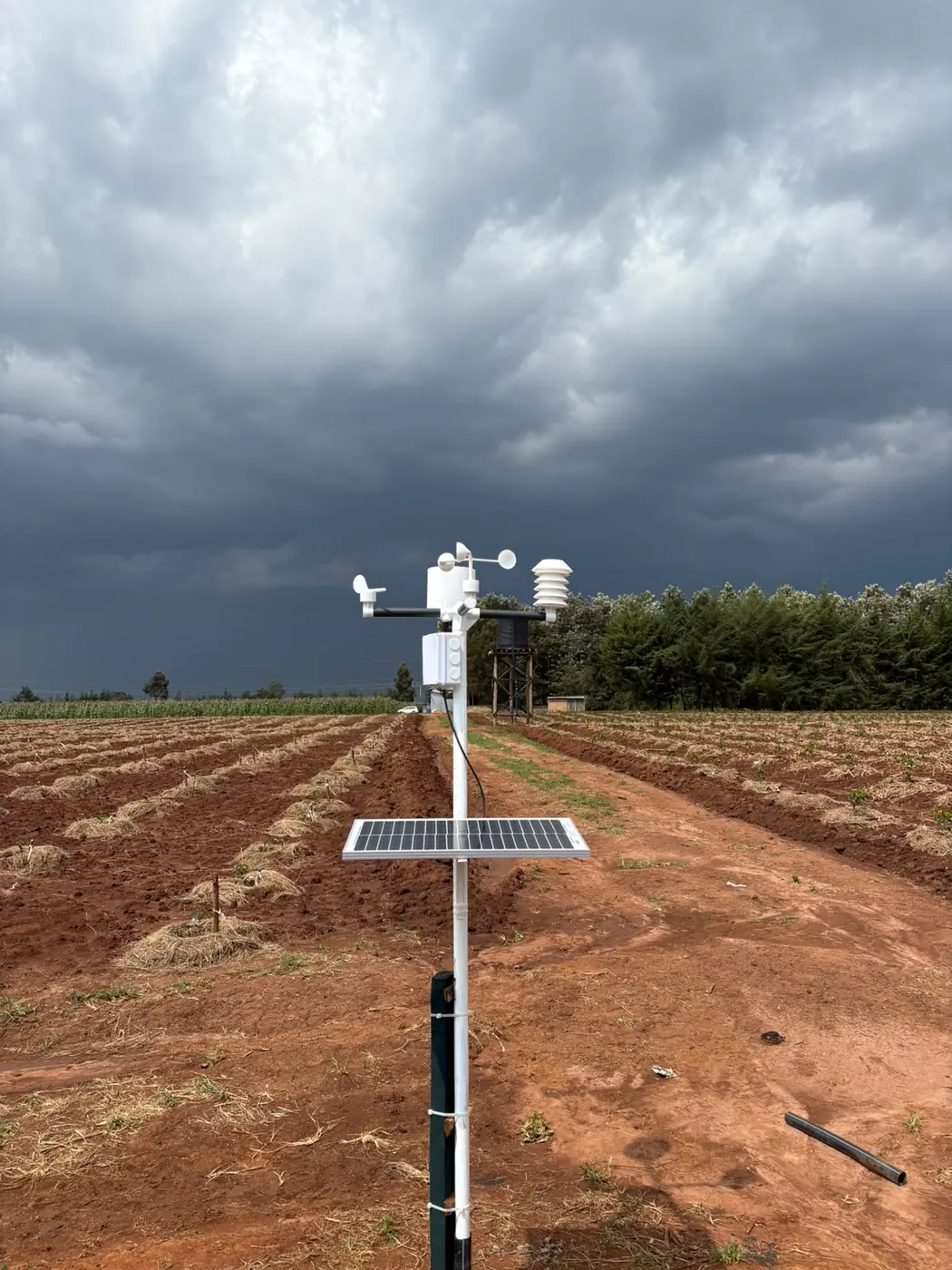
NuaSense supplies the sensors and the data services behind this: soil probes at two depths, weather stations, and county-level market data. See what NuaSense offers.