In the Long Rains of 2022, PlantVillage sent 8.8 million SMS weather messages to farmers across Kenya, and a survey of 4,272 recipients found 3,577 said the forecast helped them, mostly with planting date. That is a genuine service, and it is described in PlantVillage's account of its precision agriculture programme for smallholder farmers. But planting date is not pest pressure. Nobody in that survey said the message told them when to expect a pest outbreak, and the gap between those two things is where a lot of advice quietly overreaches.
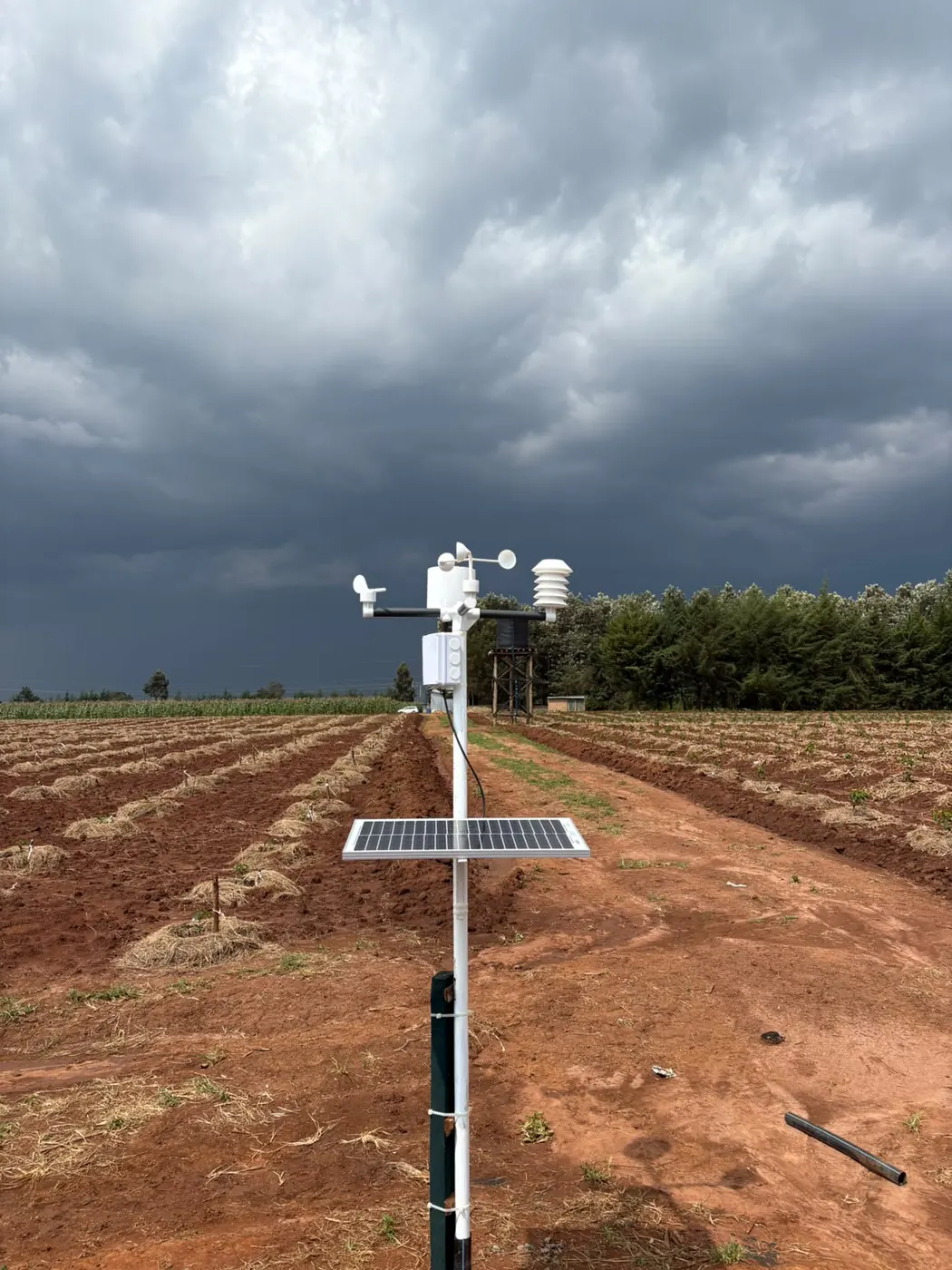
Measured by NuaSense weather stations and soil probes on Kenyan farms, over the period stated with each figure. Past readings, not a forecast.
The message that arrives, and the one that does not
A 10-day rainfall outlook tells you whether to plant. It does not tell you whether the humid week ahead will let a leaf-feeding insect population double, or whether the coming dry spell will push a soil-borne disease into a crop that is already short of water. Those are separate mechanisms, running on separate clocks, and a single SMS cannot carry both. The Kenya Meteorological Department's agrometeorological bulletins, issued every 10 days year-round, cover rainfall distribution, soil moisture, temperature and crop condition together, which is closer to what a pest decision needs. Whether that bulletin actually reaches a farmer at block level, in a form specific enough to act on, is a different question, and mostly the answer is no.
This matters because temperature and rain do not push pest risk in the same direction. A dry spell can favour one problem and suppress another. A wet spell can do the reverse. Advice that says simply watch the forecast for pest signals treats these as one signal when they are at least two, often working against each other on the same field in the same week.
Temperature moves the population, and it moves it fastest
Among the environmental drivers of insect populations, temperature is the dominant one, according to a review of climate change effects on agricultural insect pests published in PMC's overview of climate change and agricultural insect pests. Warming is expected to expand the geographic range certain pests can survive in, improve their odds of surviving winter where winter exists, and add generations to their yearly cycle. None of that requires a rain event. It is a slower, background shift, and it is the reason a warm season can carry more pest pressure than a wet one, independent of what the rain gauge shows.
Across our own weather station network, air temperature over 07 August to 06 September 2026 ranged from 3.7 to 31.6 degrees Celsius, mean 17.7, across 11 stations. That is a wide daily swing on an average Kenyan farm, and it means a pest population is rarely sitting at one steady thermal regime for long. A forecast that quotes a single expected temperature for the week is already smoothing over the range that actually governs the insect.
Rain does two contradictory things at once
Warm, humid conditions favour many pest species, and precipitation is one of the key drivers behind that, according to the Springer review of climate-smart pest management. But the same review notes crops under water stress become more vulnerable to pest damage, which is the opposite mechanism: not enough water, not too much humidity. Rain can raise pest risk by making the air wetter, or raise it by first stressing the plant through drought, and a farmer cannot tell which mechanism is in play just from a rainfall total.
The clearest large-scale example sits outside Kenya's borders but reached Kenya directly. A desert locust invasion of more than ten countries in western and northern Africa in 2004 followed heavier than normal rains, per the same review. Closer to home, twin cyclones Idai and Kenneth in March 2019 reduced rainfall over Kenya and Uganda and caused maize germination failure for some farmers, according to PlantVillage's account, and that same disruption is described as a major factor in the 2020 locust upsurge. The lead time there was months, not days, and it ran through a mechanism (rainfall anomaly, then vegetation response, then locust breeding conditions) that no 10-day bulletin was built to flag.
Where the received advice actually breaks
The advice most farmers hear is some version of: watch the forecast, and act on it. The 2004 locust build-up and the 2019 to 2020 sequence both show that the weather signal worth watching operated on a scale of months and across borders, not the 10-day window most bulletins and SMS services deliver. A farmer waiting on a 10-day forecast for locust warning is watching the wrong instrument for that particular threat. What that instrument is good for is a narrower, faster class of pest and disease pressure that plays out inside a single field over days, not a regional buildup over a season. Conflating the two is the error, and it is an easy one to make because both problems arrive under the same heading of pest pressure, even though the mechanisms and the timescales share almost nothing.
A named disease shows the mechanism cleanly
Fusarium wilt in tomatoes gives a case where the weather link is specific enough to act on. The disease is most destructive when soil temperature approaches 27 degrees Celsius, and dry weather with low soil moisture encourages it, according to research from Kenyatta University on tomato pest and disease pressure. That is a real, checkable trigger: warm, dry soil, not warm, wet air. Across our own soil probes over the same period, mean soil temperature ran 16.9 degrees Celsius, well below that 27-degree mark, with the two probe depths moving through 2.3 and 3.2 degrees respectively over the month. A grower with a probe in the ground can watch that number climb toward the risk zone directly, rather than inferring soil temperature from air temperature on a forecast.
The same paper reports Tuta absoluta, the tomato leaf miner, causing 50 to 100 percent yield reduction, and root-knot nematodes causing 28 to 68 percent losses in Kenya. Neither figure comes with a weather trigger attached in that source. It would be tempting to assume both track humidity or rainfall the way Fusarium tracks dryness, but that link is not in the research, and inventing one here would be worse than saying nothing. That gap is worth sitting with rather than papering over: the paper hands a grower a precise loss figure for two of the three problems it studies, and no environmental cue for either. Scouting still has to do the work that weather data cannot.
What humidity and leaf wetness add that temperature alone misses
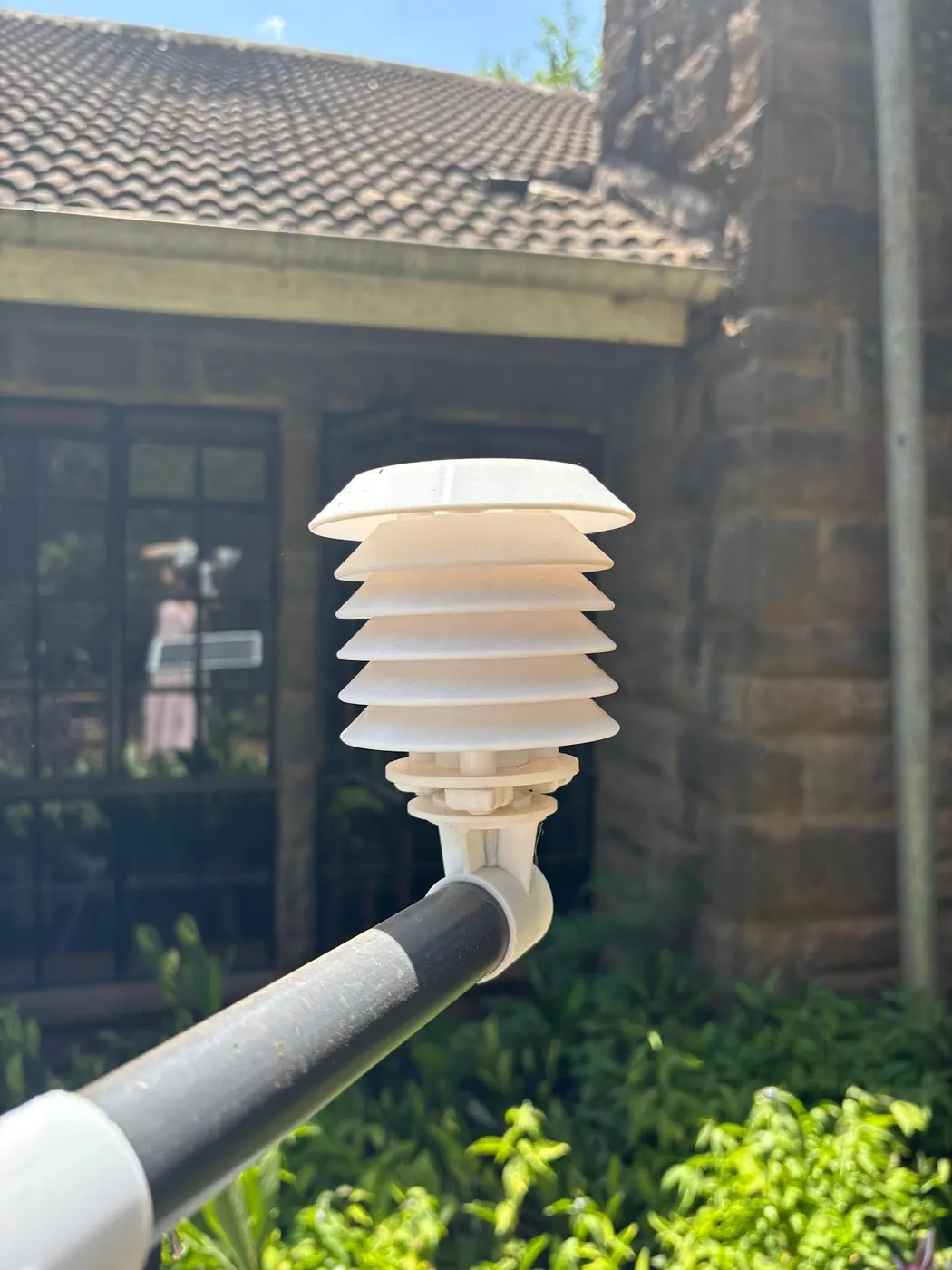
Soil temperature is one axis. The air above the crop is another, and it is measured separately for a reason. Across our own station network over the same period, relative humidity averaged 69 percent but ranged from 17 to 100, and vapour pressure deficit, a derived measure of how much drying power the air has, averaged 0.89 kPa while peaking at 3.32. Leaf wetness, also derived from the same station readings, was recorded for 26 percent of station-hours, roughly 6.2 hours in an average day. None of these numbers forecasts a pest. What they do is describe the conditions a fungal spore or a soft-bodied insect actually experiences on the leaf surface, hour by hour, which a 10-day rainfall total cannot represent at all. A week can carry the same rainfall total with the wet hours concentrated overnight, when a leaf stays damp long enough to matter, or spread thin across many short showers that dry off by midday. The rainfall figure looks identical either way. The leaf wetness hour count does not.
Our own network's spray window quality index, computed hourly from station readings on a 0 to 100 scale, scored 60 or better in only 19 percent of station-hours over the same month, and below 30 in 52 percent of them. That index folds humidity, wind and leaf wetness together into a single operational number, and it is a reminder that most hours on most days are simply not good hours to be out with a sprayer, independent of whether a pest threshold has actually been crossed. A farmer relying on the calendar to decide when to spray is fighting the atmosphere as much as the pest.
What a soil probe actually buys you that a forecast cannot
A 10-day bulletin reports expected conditions across a wide area. A probe reports what is happening in your own soil, in the same field the disease will actually attack. Over the same 07 August to 06 September stretch, our shallow and deep probes averaged 67 percent of sensor scale for moisture, with most readings between 18 and 90 percent. That range is the point: a field average tells you little about whether one corner has dried out enough to invite Fusarium while another stays wet. IoT soil and weather sensors report at the scale a single block actually varies at, roughly every 10 minutes, which a county-level bulletin cannot match. That is a genuine advantage, and it is a narrow one: it tells you soil condition, not pest counts, and somebody still has to walk the crop.
This is also where the residual effects of past inputs matter. A field carrying manure from an earlier season holds water and nutrients differently than a freshly mineral-fertilised one, and the previous piece on how long manure keeps feeding soil found that residual window running four years in before tapering off. A soil moisture reading on that field means something different depending on which input history sits under it, and a bare forecast has no way to know that history at all.
The bulletin was never built for a single farm
Kenya's agrometeorological bulletins are issued every 10 days and cover rainfall distribution, soil moisture, temperature and crop condition, feeding into national early warning systems for food security risk, per the Kenya Meteorological Department's own description of the service. That is the right resolution for national planning and the wrong resolution for a farm manager deciding whether to walk a specific greenhouse this week. The bulletin was designed to answer a food-security question at county or national scale. Reading it as a field-level pest warning system asks it to do a job it was never built for, and the disappointment that follows is not the bulletin's fault so much as a mismatch of scale.
NuaSense's overview of IoT applications already in use on Kenyan smallholder farms covers where low-cost sensor technology and mobile platforms have started filling that resolution gap, pest and soil monitoring included. The pattern across all of it is the same: national data sets context, farm-level instruments set the trigger.
What farmers were already reading before any forecast existed
A study of indigenous knowledge practices for managing key crop pests in Kitui West sub-county found farmers already reading signals the formal system does not publish: plant behaviour, insect activity, timing cues tied to local seasonal memory, described in the Kitui West study on indigenous pest management knowledge. That knowledge is local by construction, tied to one place's rainfall pattern and one place's pest history, which is exactly the resolution a national bulletin cannot offer and a sensor network can only approximate with enough time in the ground. It is worth taking seriously rather than treating as folklore waiting to be replaced by hardware. The two are answering the same question from different directions.
What neither the indigenous record nor the national bulletin can do is tell you, this week, whether your soil has crossed 27 degrees or whether your leaves are staying wet long enough for a fungal spore to take hold. That is a measurement question, not a forecasting one, and it is worth being honest that no source in this piece hands you a lead time in days for most named pests. The evidence supports temperature and rainfall as drivers, and supports specific mechanisms for specific diseases like Fusarium wilt. It does not support a general rule that says act X days after weather event Y for pest Z, because that rule has not been tested at that resolution in Kenya.
Reading your own record instead of waiting for one
The honest position is that the forecast and the bulletin both matter, and both stop short of where a field decision actually gets made. What closes that gap is a record: your own soil temperature climbing toward the range a named disease favours, your own moisture readings showing a corner of the field has dried past what the crop can tolerate, your own humidity and leaf wetness hours stacking up in a way that matches a known mechanism rather than a guess. None of that requires predicting the weather. It requires measuring it, on the field where the decision has to be made, and comparing it against a threshold that a named study actually tested. The forecast gives you the season. The probe gives you the week. Neither gives you the pest count itself, and a walk through the crop still has to close that last step.